Relocation Home Buying Guide: How to Buy in a New City or Country Without Regret
10 Mar 2026Relocating is hard. Buying property remotely is harder. Learn how to choose the right agent, tour remotely, manage timelines, and avoid cross-border surprises.
1. Relocating is one of life’s biggest transitions
You’re changing your environment, routines, and often your identity: new neighborhood, new language, new commute, new social circles, new expectations. Adding a home purchase on top of that can feel like trying to solve a puzzle while the table is moving.
When you relocate within the same city, you already know the neighborhoods and market norms. When you relocate to a new city, or across borders, your uncertainty multiplies:
Which neighborhoods are actually livable for your day-to-day life?
How do local buying rules work?
Who can you trust when you can’t meet everyone in person?
How do you tour homes efficiently?
How do you coordinate time zones, paperwork, and deadlines?
This guide is built for buyers (and sellers) navigating relocation or cross-border transactions. It’s not legal or tax advice those details vary by jurisdiction but it will give you a practical decision framework and a process that reduces risk.
2. The relocation challenge isn’t just distance, it’s information asymmetry
Local buyers have advantages:
they know which streets are noisy
they understand local pricing patterns
they can tour quickly
they recognize “good value” faster
Relocating buyers don’t have that instinct, yet. And that’s okay, as long as you build a process that replaces instinct with structure.
Your goal is to reduce information asymmetry by:
gathering neighborhood intelligence
creating a repeatable evaluation system
working with the right local expert
centralizing communication and documents so nothing falls throughty, not just list-price ego.
3. Start with “life-first criteria,” not listings
Relocating buyers often start by browsing listings. But the better sequence is:
Define your life constraints
Identify neighborhoods that match those constraints
Then browse listings only in those areas
Life-first criteria could include:
commute time (in real conditions, not maps optimism)
access to schools or childcare
walkability vs quiet
proximity to transit
community vibe (families, nightlife, green space, etc.)
budget comfort (including fees and taxes)
long-term flexibility (resale or rental potential)
In cross-border moves, add:
language comfort and administrative complexity
banking/financing feasibility
residency status effects (where applicable)
When you anchor on life criteria, you avoid buying a “great house” in the wrong life context.
4. Why agent selection matters even more when relocating
If you’re local, you can compensate for a mediocre agent with your own knowledge and presence. When you’re remote, you can’t.
A relocation-strong agent should be:
hyper-local in neighborhood expertise
comfortable with remote coordination
proactive with updates and documentation
able to translate local buying norms clearly
honest about tradeoffs (not just “selling the dream”)
This is why a matchmaking approach (like Anyone.com’s positioning) is compelling in relocation contexts: the goal is to reduce the randomness of agent selection and connect you with someone who fits your scenario rather than whoever is loudest online.
5. Remote tours: treat them like a product demo, not a casual FaceTime
Remote tours can be incredibly effective if you do them right.
Ask for:
a structured walkthrough (not just “here’s the kitchen”)
close-ups of known risk areas: windows, ceilings, under sinks, electrical panel, exterior
noise test: open windows for 30 seconds
water pressure test (where feasible)
a “street view” walk outside
cell signal check (yes, really)
Create a standard tour checklist and use it every time. Consistency makes comparisons fair.
Pro tip: Have your agent record the tour so you can rewatch and share with family. Memory is unreliable when you’re processing a new environment.
6. The neighborhood research stack (what to do when you’re not there)
To evaluate neighborhoods remotely:
Study commute routes at the times you’d actually travel
Compare amenities: groceries, gyms, parks, hospitals
Look at planned development (construction can change everything)
Ask locals targeted questions in community forums
Use street-level imagery to understand block-by-block differences
Visit in person if possible before you commit—especially cross-border
If you can visit once, use that trip for neighborhoods, not houses. Houses come and go. Your location decision lasts.
7. Cross-border considerations: build a “jurisdiction checklist”
Cross-border buying can introduce:
different purchase structures
different closing processes
different disclosure norms
different property taxes/fees
different financing rules
different timelines and administrative requirements
Because specifics vary, your best tool is a checklist:
What are the steps from offer to closing here?
Who are the required parties (notary, attorney, escrow)?
What documents do I need as a non-local buyer?
How long do typical closings take?
What are standard contingencies (inspection, financing, appraisal equivalents)?
What fees should I expect at closing?
Ask your agent to outline this in plain language. A good agent can’t replace legal counsel where necessary, but they should be able to explain the process and coordinate the right professionals.
8. Managing time zones and decision speed: set a communication agreement
Relocation deals go sideways when:
messages are missed
documents are delayed
decisions are made too slowly
deadlines aren’t tracked visibly
Before you go deep with any agent, set:
your preferred communication channels
expected response times
weekly check-in schedule
where documents will live
how deadlines will be tracked
This is one reason an end-to-end workflow platform can be valuable: fewer scattered threads means fewer missed steps.
9. Financing when relocating: plan early, reduce surprises
Financing can be trickier when:
your income is from another country
your employment is changing
your credit history isn’t local
currency exchange affects affordability
Start financing conversations early and build multiple scenarios:
best case
conservative case
“if rates or fees change” case
Even if you end up buying with cash, a financing plan is still useful because it clarifies what you can do quickly when the right home appears.
10. Timelines: align your move date with transaction realities
Relocating often has a hard date:
job start
school year
lease end
visa/residency timeline
family needs
But real estate doesn’t always respect your schedule. To reduce risk:
define your “must move by” date
define your “ideal close” window
build a buffer for delays (inspection issues, paperwork, financing)
consider temporary housing if the dates don’t line up cleanly
The most painful relocation outcomes happen when buyers force a purchase under time pressure. If you can buy with patience, you get better options and better negotiation leverage.
11. How to make a confident decision remotely
Relocation decision confidence comes from three things:
A repeatable evaluation system
A trustworthy local agent relationship
Centralized visibility into the transaction steps
A simple remote decision framework:
Pass/fail criteria: location constraints, budget comfort, property type needs
Risk score: condition, unknowns, inspection likelihood
Lifestyle score: commute, daily life, community fit
Resale/rent flexibility: how easy is it to exit if life changes?
If a home passes the fundamentals and the risks are understood—not ignored—you can act without needing “perfect certainty.”
12. Where Anyone.com fits in a relocation journey
Relocating buyers often need two things:
the right local agent (fit matters more remotely)
a clear, centralized workflow (to manage complexity)
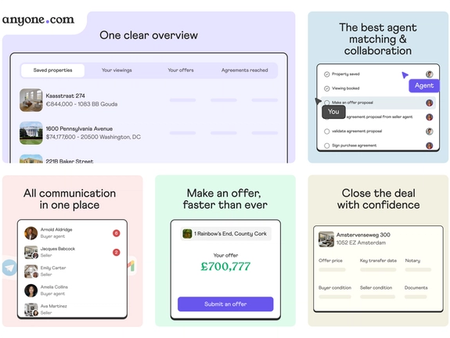
Anyone.com’s positioning, agent matchmaking plus an end-to-end transaction workspace, maps well to those needs:
reduce randomness in selecting an agent
keep communication, showings, offers, and next steps visible in one place
reduce administrative friction when you’re coordinating from afar
The value isn’t “tech for tech’s sake.” It’s peace of mind through structure.
13. Relocation Buyer Checklist (Quick Version)
Before you shop:
life-first criteria defined
shortlist 3–5 neighborhoods
financing scenario planning started
agent selected (with remote process experience)
tour checklist created
During the search:
consistent remote tours
neighborhood research system
decision framework used for every property
deadlines tracked centrally
After offer acceptance:
inspection plan
document requirements confirmed
closing timeline buffered
moving plan coordinated with transaction milestones
Closing thought
Relocation doesn’t have to mean buying blind. If you replace “guesswork” with a structured process and partner with the right local expert you can make a confident purchase even from a distance.
A cross-border or out-of-city move is already a big life transition. Your home purchase process should reduce stress, not add to it.
Overview
Share via
Other articles
28 Apr 2025
Sellers are left out of real e...
The traditional home selling process is messy: manual processes, unclear steps, unverified buyers, missed opportunities and close to zero transparency for sellers. At Anyone, we believe selling your home should feel as seamless as boo...