Buying a Home Abroad as an Expat: A Step-by-Step Guide (2026)
08 Jun 2026Moving abroad is exciting, right up until you start working out where you'll actually live. Then the mortgages, the legal requirements, the old forum threads, and the fifteen open tabs pile up, and at some point you stop looking for a home and start trying to figure out where to begin. If that's you, you're in good company, and you're less stuck than it feels. Plenty of people buy across borders these days: in one survey, nearly half of those who'd bought in the past two years made an offer without ever seeing the place in person (LendingTree), and people relocating lead the way. Most of the stress comes from having the whole process scattered across a dozen sources. So here it is in one place, step by step, with the bits that tend to trip expats up.
Why Buying Abroad Feels So Different (the part nobody explains)
Buying a home is a big decision anywhere. Back home, though, you've got a head start. You know the language, you roughly know how it works, and you know who to ask when you don't.
Move abroad and that head start vanishes. Suddenly you're dealing with an unfamiliar market, different rules, a new financial system, and a process that might look nothing like the one you grew up with.
And the issue is rarely too little information. It's too much. Property portals, government pages, mortgage sites, a friend-of-a-friend who bought here years ago, all of them telling you something slightly different. By the time you've read twenty of them, you're usually more confused than when you started. What helps is knowing which bits actually apply to you.
Common Mistakes Expats Make When Buying Abroad
When everything feels uncertain, people tend to do one of two things: rush, or freeze. Both get expensive.
The big one is diving into viewings before sorting the basics, like whether you're even allowed to buy, what you can realistically afford, and whether a lender will say yes. Falling for a place you can't finance, or can't legally buy as a non-resident, is a rough way to learn the rules.
Close behind is assuming it all works like it did back home. Offer rules, taxes, paperwork, even who the agent is really working for, all change from one country to the next. A surprise near the finish line can cost you weeks.
Then there's information overload. Buying abroad has a lot of moving parts, and cramming twenty articles into one evening tends to leave you foggier than when you started. A simple map of the journey does more for you than another stack of disconnected facts.
The Expat Buyer Journey, Step by Step
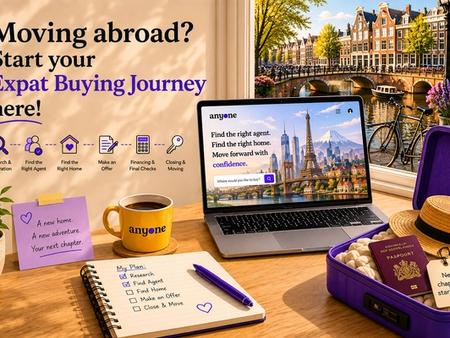
Every country has its own rules, but the path most expats walk looks pretty similar. Here's the order it usually goes in, with the things that surprise people built into each step.
1. Research, eligibility, and your local number
It starts with research: locations, markets, costs, budget. While you're at it, get the dull groundwork out of the way, because that's what saves you later.
Check that you can actually buy. In a lot of countries foreigners buy with no trouble, but some restrict it or add extra taxes for non-residents, and the rules shift from year to year. Look up where your target country stands right now.
Then sort your local number. Most countries want a tax or ID number before you can buy or borrow, the BSN in the Netherlands, the NIE in Spain, the codice fiscale in Italy. Apply early, because almost nothing happens without it.
2. Decide how you want to buy: with an agent, or direct
Here's a fork a lot of expats don't realize they have. You don't actually need a buyer's agent to buy a home. On Anyone you can message sellers and listing agents, book viewings, and make and track offers yourself, all from one place.
And in countries where you'd normally hire and pay your own buyer's agent, skipping that fee is real money. In the Netherlands, an buyer agent usually runs about €2,500 to €5,000, and more like €5,000 to €8,000 in Amsterdam, or roughly 1 to 1.5% of the purchase price. Go direct and that stays in your pocket. (In markets where the seller covers both agents, there's no separate buyer's fee to save, but going direct can still give you more room to negotiate.)
Just go in knowing one thing: the agent on a listing works for the seller, not for you. Their job is to get the seller the best deal. So if you want someone purely on your side, that's a separate person, a buyer's agent, or an "aankoopmakelaar" if you're in the Netherlands. When you're working in a second language in a market you don't know yet, that backup can be worth the fee.
If you do want one, experience alone won't cut it. Look for someone who knows the area, speaks your language comfortably, has handled international buyers before, and is properly licensed where you're buying. Finding that person cold is hard when you've just arrived and can't ask friends or family for a name, which is where a matching service helps, since it points you toward agents who fit instead of leaving you to guess.
And you're not locked in. You can start on your own and bring in an agent later, or the other way around.
3. Find the right home
Now the fun bit. You're scrolling listings, comparing neighborhoods, picturing the life. Whether you're searching solo or an agent is lining up options for you, the mess usually comes from spreading it all across different sites, listings here, messages there, viewings somewhere else.
If you're still abroad, viewing remotely is completely normal now. Nearly half of recent buyers have made an offer without setting foot inside first (LendingTree), and people relocating lean on video tours and live walkthroughs the most. Do your area research from afar too, commute times, noise, what's nearby, before you spend money on a flight. And keep your shortlist short instead of chasing every place that catches your eye.
4. Make an offer
Once you find the one, things speed up, and offer rules vary more than you'd expect. Some markets haggle out in the open. Others, including parts of the Netherlands, run sealed bids, where everyone puts forward their best number at once, often over asking.
Find out how it works locally before you bid, and know which conditions you can attach, like subject to financing or subject to a survey, so you're covered if something falls through. Whether you put the offer in yourself or an agent does it for you, a mortgage agreed in principle really pays off here. It makes your offer credible, and in plenty of markets a seller won't take you seriously without one.
5. Financing and final checks
With an offer accepted, the focus moves to financing, paperwork, and checks. Expect a valuation, maybe a structural survey, and a steady trickle of documents from your lender.
Two things tend to catch expats out. Lenders often ask non-residents and recent arrivals for a bigger deposit than locals, and they look hard at your income and contract, so freelance or foreign income usually means more paperwork. And if you earn in one currency and buy in another, the exchange rate can move your budget around between the offer and the day you pay, so plan how you'll handle that early.
Whether you're managing this stretch yourself or an agent is, the job is the same: stay on top of the requirements and deadlines, because delays here can sink a deal.
6. Closing and moving
After weeks or months of looking, the end finally shows up. Contracts get signed, often in front of a notary or closing agent, the last details are settled, and you get the keys. If you've got an agent, they'll steer the final paperwork; going direct, you handle it, with the documents and the notary step kept in one place. If you can, walk through the property one more time before you sign, and line up any cross-currency transfers well ahead of time. Then the thing that felt impossible a few months ago is just home.
Frequently Asked Questions
How We Help at Anyone.com
At Anyone.com, we think buying a home, even in a new country, should feel clear, organized, and properly in your hands.
So we pull the key parts of the journey onto one platform. Finding homes, contacting agents, booking viewings, making offers, sharing documents, arranging the notary or closing, it all lives in one place instead of fifteen tabs. And because Anyone.com runs across 29 markets with cross-border buyer discovery switched on by default, you can search and get served listings well beyond a single local portal, which counts for a lot when the right home, or the right move, crosses a border.
You decide how you want to buy, and you can switch paths whenever you like.
Search and buy on your own
If you'd rather lead your own search, you get the tools to do it properly, and you skip the buyer's-agent fee while you're at it (in the Netherlands, often a few thousand euros):
Search across 29 markets in one place. Browse verified listings at home and abroad, without a different portal for every country.
Book viewings and message directly. Set up in-person or virtual viewings and talk to agents and sellers straight from your workspace.
Make and track offers. Send offers and follow every reply in one thread, so nothing gets buried in email and chat.
Keep the paperwork together. Share documents and arrange the notary or closing in the same place you did everything else.
Prefer expert support? Get matched with a trusted local agent (free)
If you'd rather have a pro beside you, Anyone can help you find the right local agent for your situation, and the matching is free. Based on your goals and filters like location, language, experience with international buyers, and how they work, you get matched with agents who actually fit, instead of choosing blind. And since the whole journey still runs in your Anyone workspace, you always know what's going on and what's next.
Either way, you stay in charge of the process and always know your next step.
Ready to Start Your Search?
A home in a new country is a big thing to take on, but it's far more doable than that first hour of open tabs makes it look. Get the right local people around you, keep the steps in order, and it turns from a guessing game into something you can actually run.
Wherever you are right now, still researching, hunting for an agent, or ready to book viewings, the move that matters is the next one. So pick your path and take the next step today!
Author: Delano Bossé from Anyone.com
Other articles
05 Oct 2026
Anyone.com vs FSBO Platforms W...
We compared the leading FSBO, private-sale, flat-fee MLS, online-agent and owner-listing platforms across the 29 markets where Anyone.com operates. The differences are much bigger than their similar promise of helping you sell without ...

30 Sep 2026
The Strongest Buyer's Market o...
There are 58% more home sellers than buyers in America, nearly half of buyers are getting concessions and three in five homes sell below their original asking price. Yet a 7% mortgage still makes buying feel brutally expensive.

24 Sep 2026
Elastic Features Anyone.com: T...
A look inside the data pipelines, search technology and ranking systems that power Anyone.com and prepare the platform for AI transaction experts.

26 Aug 2026
The $100 Million Listing War: ...
Portal disputes and private listing networks are changing who gets to see a home, who controls access and whether privacy still belongs to the seller.